

Prerequisites
- A pgvector-enabled Postgres database with the Brain migrations applied.
- Global embedding and distillation provider settings.
- Project Brain enabled in project settings.
- For an agent, explicit Brain read or write permission on its project attachment.
Two knowledge tiers
Decisions and directions prefer a declared canonical home. When such a home
exists, an agent must propose a change to that source instead of silently
creating a competing memory item.
Configure providers
Open Settings → Project Brain providers as a global administrator and set:- embedding base URL, model, dimensions, and an
env:NAMEAPI-key reference; - optional separate distillation URL, model, and key reference;
- otherwise, distillation uses the embedding provider route.
Enable Brain for a project
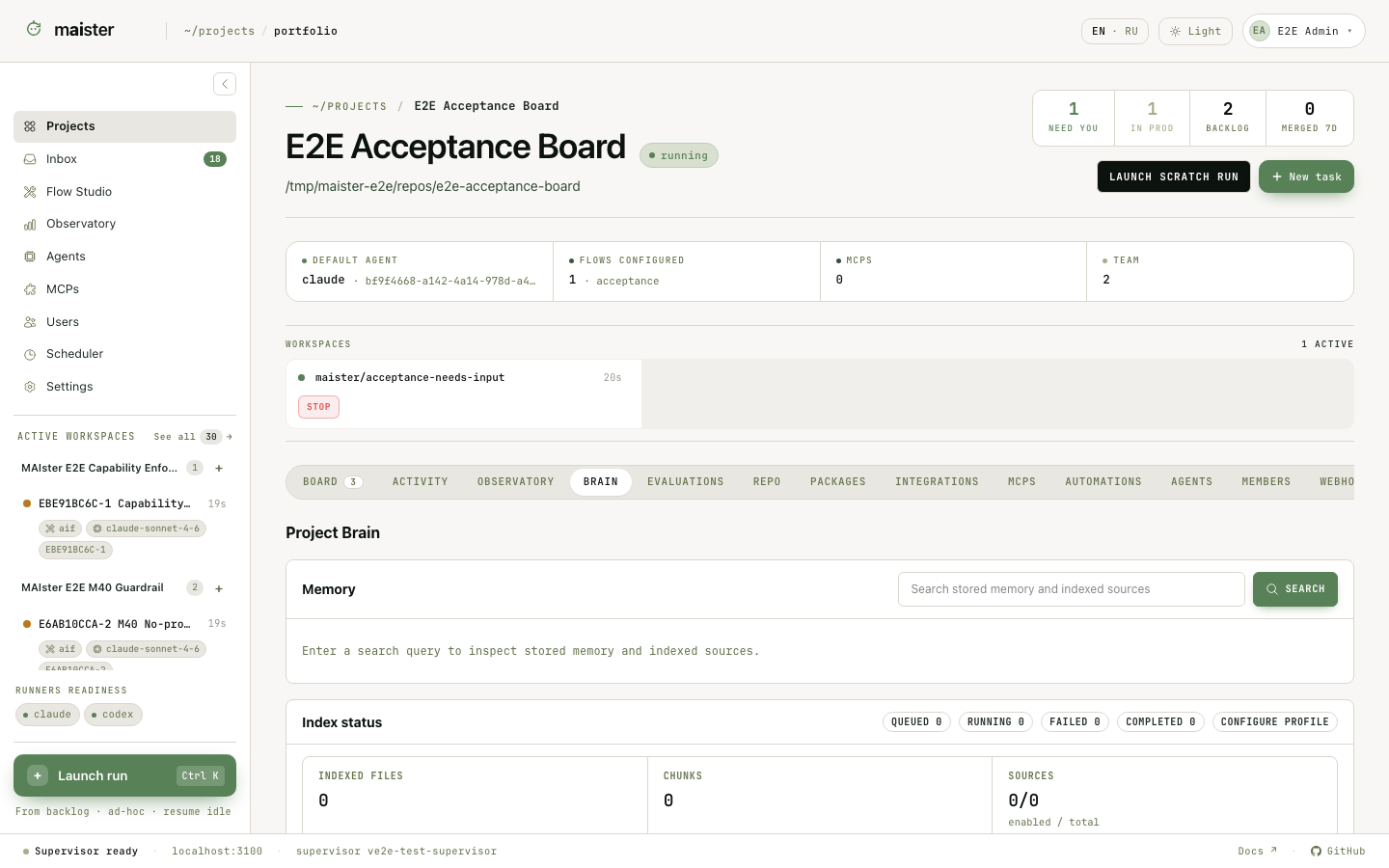
Open Project → Settings → Brain. Enabling is refused until embedding and distillation configuration is complete. Then open Project → Brain to manage sources and indexing. A source identifies a bounded repository-relative path or glob. MAIster reads tracked content from the project’s default branch, chunks it with a typed parser, stores source pointers and previews, and creates vector embeddings. Ignored, untracked, absolute, or escaping paths are refused. Indexing runs through scheduler jobs. Repository events can enqueue source reindexing, and an operator can request it manually. The source row shows the last indexed time and a deterministic error when a file, glob, parser, or provider prevents progress.Recall
Recall embeds the query once and combines:- vector similarity against the active embedding generation;
- lexical rank over indexed chunks and owned memory;
- confidence and lifecycle policy for retained items.
.maister/run.json,
and marks them as background context rather than instructions. A provider outage
does not fail the Run; it omits ambient context and leaves a diagnostic signal.
Retention and improvement
Terminal Run and gate events can be distilled into a bounded lesson. Near duplicate lessons and observations reinforce an existing item. A changed state fact supersedes the old fact. Time-limited items expire through the scheduler; state facts do not decay in the same way. Recurring evidence can become an improvement proposal:- MAIster groups related retained evidence.
- A person or the
core:improveragent drafts a proposal. - A person accepts, rejects, or revises it.
- Accepted rule, skill, or Flow changes become unpublished local drafts.
- Documentation, roadmap, or state changes can become board tasks routed through the project’s normal delivery process.
Platform agents
A platform agent is a package-defined actor with a runner policy, workspace mode, capability profile, triggers, budget, and project attachment. Use one for bounded routines such as triage, monitoring, error handling, dependency review, pull-request assistance, or knowledge maintenance. Use a Flow for the reusable delivery process that produces and validates a project change. Built-in examples include:
The agent attachment has separate
can read Brain and can write Brain grants.
Write access permits retention and proposals; it does not permit publication.
Failure signals
- Brain tab absent: the project has not enabled Brain or the installation is not provisioned.
- Enable refused: configure both embedding and distillation models first.
- Source error: correct the repository-relative path, reduce an overbroad glob, fix parsing, or restore provider access.
- Embedding unavailable: retry after transient provider failure; deterministic authentication or request errors require configuration changes.
- No ambient context: the Run did not opt in, the project is disabled, no item met the confidence threshold, or recall degraded safely.