

Prerequisites
- Global
adminaccess. - The target coding-agent CLI installed on the execution host.
- Provider authentication already configured for that CLI, or provider secrets available in the supervisor process environment.
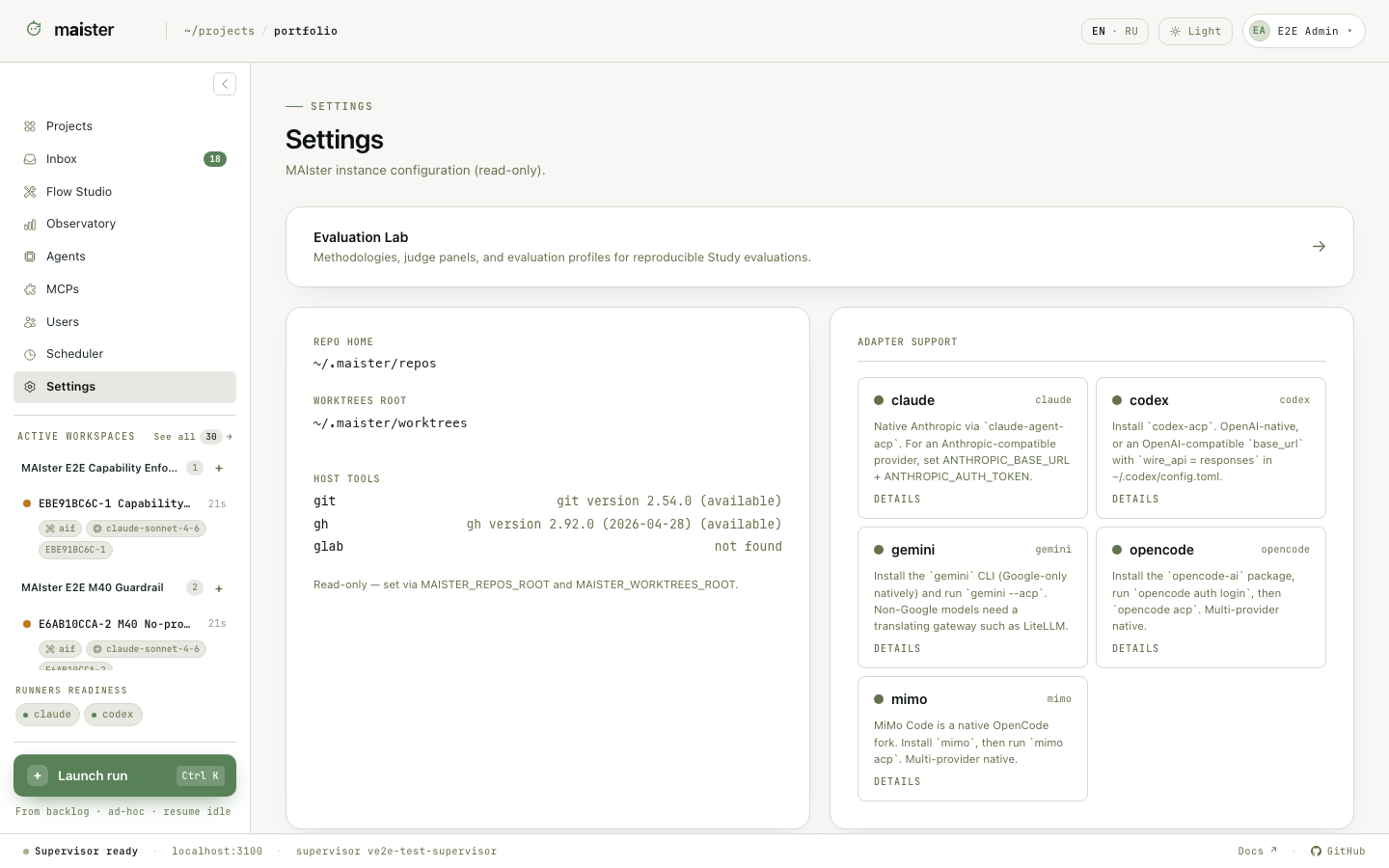
Supported adapter families
MAIster keeps Claude, Codex, Gemini, OpenCode, and MiMo in one runner catalog. Provider routing includes Anthropic, OpenAI, Google routes, agent-native routes, and compatible endpoints such as OpenRouter. Each concrete profile still has its own readiness result.Create a runner
- Open Settings → ACP runners.
- Add a runner and select its adapter family.
- Set the model and provider route.
- Put secret values in the supervisor host environment. Enter
env:NAMEin the runner field that should resolve that variable at launch. - Keep the runner disabled until diagnostics are available.
- Enable it after the row reports Ready.
- Set a platform default only if the runner is a safe fallback for normal work.
Understand readiness
Readiness combines configuration and live host diagnostics. A row can be unavailable because the binary is missing, an executable override is invalid, the provider kind is unsupported, an environment reference is absent, or an ACP initialization probe failed. Normal Ready and read-only eligibility are separate signals. Standalone agents that useworkspace: none or repo_read require a runner whose adapter
supports read-only sessions and, when required, has current read-only probe
evidence. A runner can therefore be ready for a normal Flow and still refuse a
read-only platform agent.
ACP is a two-way control channel
The supervisor does more than start a terminal command. ACP carries prompts and session events in both directions. It allows MAIster to:- surface a coding agent’s permission question to a person instead of forcing a YOLO-style session;
- send the selected permission response back to the live session;
- interrupt or stop work;
- send a corrective prompt or resume a supported session;
- stream the agent’s progress into the Run workbench.
Bind runners to Flow work
A Flow can declare named sessions and runner slots. A project resolves every slot when it connects the Flow or first launches it. The resolved runner is snapshotted in the Run, so later catalog edits do not rewrite history. Different nodes can share one session or use different sessions. This lets a Flow assign different coding agents and model price/performance levels to planning, implementation, verification, and judging. The team defines the policy once; individual contributors do not have to switch models manually for every task. Use a more capable model where complexity or evaluation warrants it, and a faster or cheaper profile for routine work. Confirm the result in Observatory and compare quality in an Evaluation Study.Failure signals
EXECUTOR_UNAVAILABLE: no enabled, Ready runner satisfies the hard adapter capability or required read-only evidence.- Configuration ambiguity: several exact matches exist and the project must bind one explicitly.
- Soft intent warning: MAIster found a compatible fallback, but its model or provider differs from the Flow’s requested intent. The warning is stored on the Run without exposing secrets.