

Start the clock
SetMAISTER_CRON_TOKEN on the web process. In production, call GET or POST /api/cron/tick from an external cron service with
X-Maister-Cron-Token: <token> or Authorization: Bearer <token>.
A single-host installation can use the in-process timer:
503.
Inspect global jobs
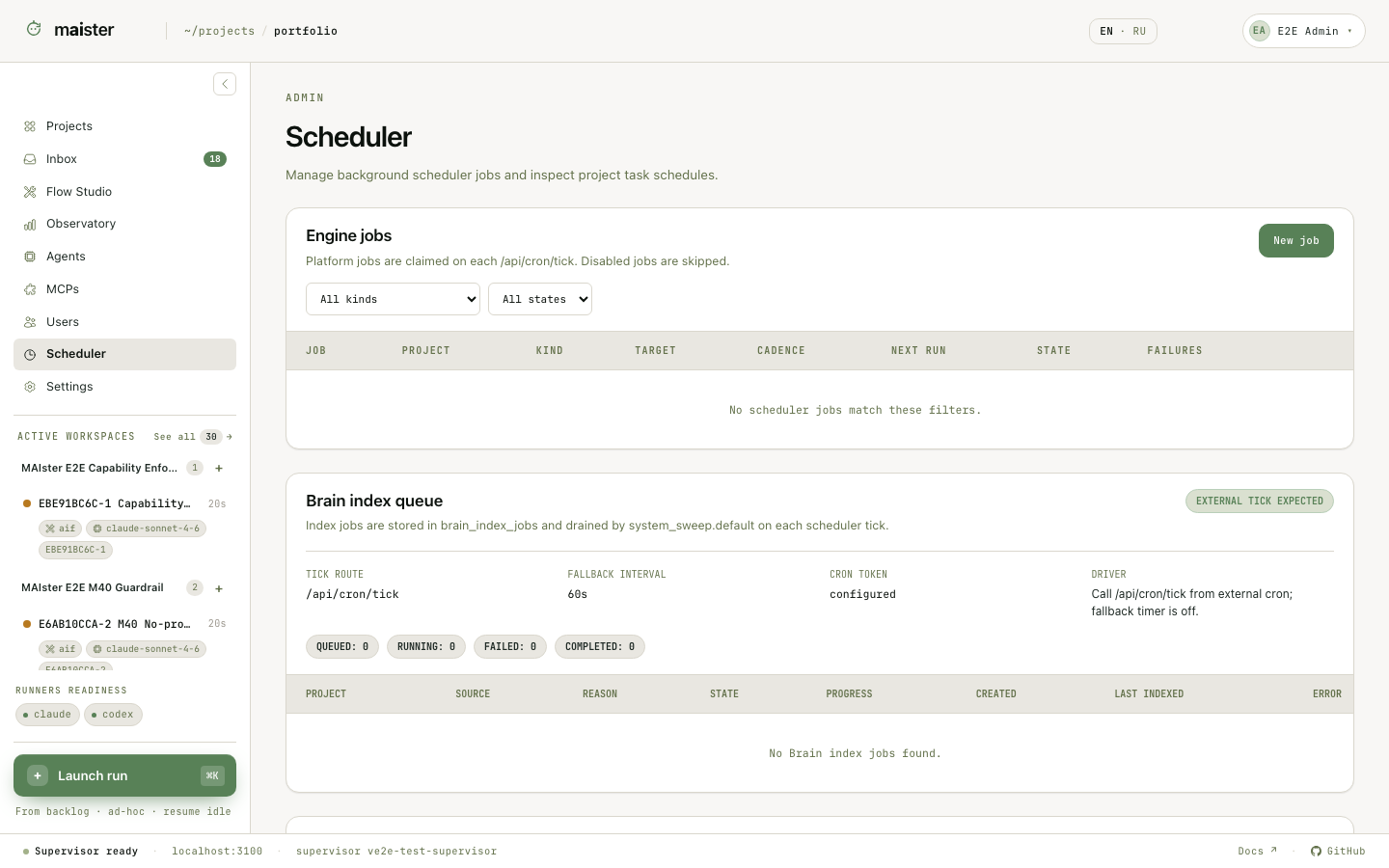 Open Scheduler as a global administrator. The table shows the job kind,
target summary, cadence, next run, enabled state, consecutive failures, and the
last attempt. The page also links task schedules and one-time launch intents
back to their projects.
You can create two operator job types from this screen:
Open Scheduler as a global administrator. The table shows the job kind,
target summary, cadence, next run, enabled state, consecutive failures, and the
last attempt. The page also links task schedules and one-time launch intents
back to their projects.
You can create two operator job types from this screen:
- Flow run targets a task and starts it with the selected branches and runner choices.
- Command performs an HTTP health request or a host ping.
Schedule project work
Project → Automations combines three kinds of future work:- A one-time task launch. Open the task launch form, choose Schedule, set local date, time, timezone, and DST handling. MAIster stores an intent and creates the Run only after a scheduler tick claims it.
- A recurring task schedule with cron expression, timezone, catch-up behavior, branches, Flow, and runner selection.
- Platform-agent cron or event bindings. The page shows them and links to Project → Agents, which owns their settings.
Diagnose a missed launch
- Open Project → Automations and check the intent or binding state, next time, timezone, and latest safe outcome.
- Confirm that the task has no blocking relation and that its Flow, runners, package trust, and MCP bindings are ready.
- For an agent trigger, edit the attachment in Project → Agents and check that both the agent and binding are enabled.
- Open the global Scheduler. Check the dispatcher job, tick recency, failure count, and last error code.